

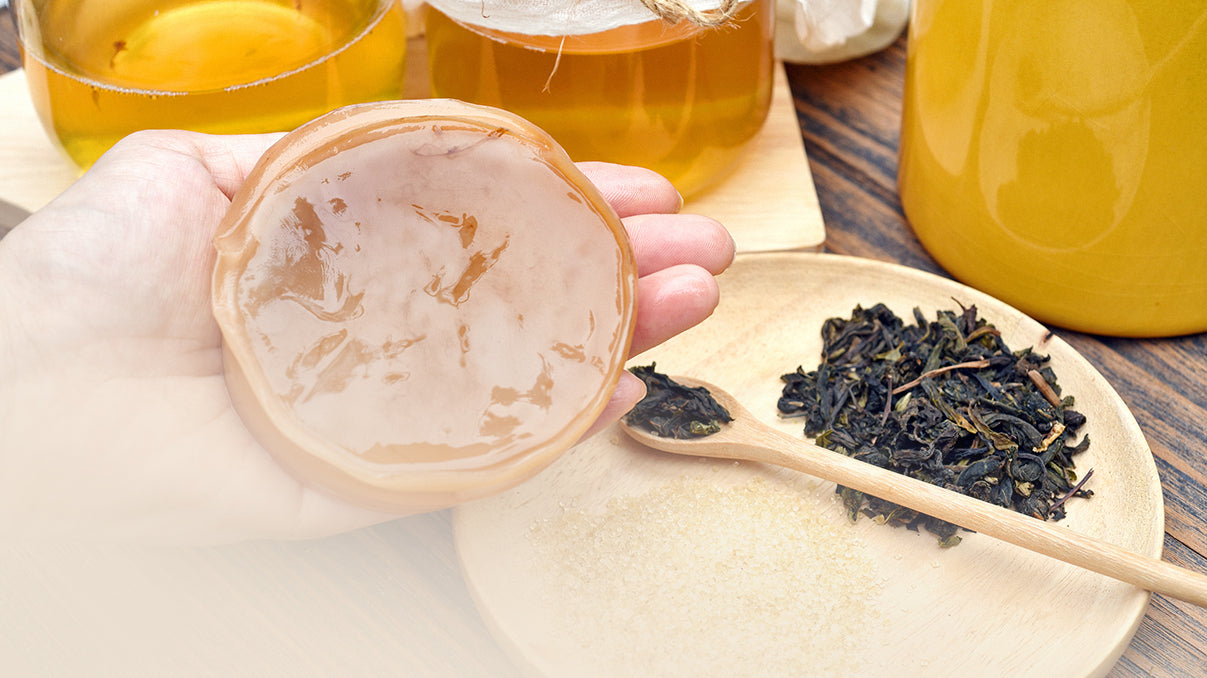

You're probably asking yourself: What is a "mushroom" doing in my drink? In fact, the kombucha tea mushroom is neither a classic mushroom nor a lichen, but a cellulose matrix colonized by microorganisms. You can find out how to use this kombucha culture yourself at home in this post. In addition to all sorts of interesting facts about the tea fungus, we also want to tell you how you can grow your own kombucha mushroom at home in a fermentation vessel.
Kombucha? Tea Fungus? The Basics at a Glance!
Kombucha (pronounced: kom-boo-cha) is a fermented beverage made from tea in a fermentation vessel. It involves bacteria and yeasts, which form the so-called kombucha mushroom (SCOBY = SYMBIOTIC CULTURE OF BACTERIA AND YEASTS). The kombucha mushroom enables the fermentation of sweetened tea and thus shapes the composition and typical taste of the finished kombucha.
What do you do with a kombucha mushroom? With good care, a kombucha culture can be used for new fermentations over a long period and repeatedly for homemade kombucha.

What is the Kombucha Tea Mushroom Made Of?
The SCOBY is not a lichen and not a classic mushroom. Its visible structure consists predominantly of bacterial cellulose, in which bacteria and yeasts of the kombucha culture live. Therefore, it is sometimes mistakenly referred to as a yeast fungus. Yeasts can metabolize sugar into ethanol and carbon dioxide, among other things. Certain acetic acid bacteria can then convert ethanol into organic acids such as acetic acid in the presence of oxygen.
Kombucha mushrooms are usually round like a pancake and their consistency is somewhat slimy. Their surface can be smooth, but also very uneven. During the fermentation process, holes or small bulges can form in the Scoby – this is completely normal! Depending on the liquid content, the kombucha tea mushroom is more or less glassy in its composition.
Depending on the culture, tea, and fermentation conditions, the following components, among others, have been described in various kombucha studies. Not all are automatically present in every SCOBY or kombucha or in nutritionally relevant quantities:
- Types of bacteria
- Acetic acid bacteria
- Yeast strains
- Enzymes
- Depending on the starting materials and fermentation, various vitamins have been detected in scientifically examined kombucha samples. However, a general vitamin composition for every kombucha cannot be derived from this.
- Minerals and trace elements such as iron, magnesium, calcium, copper, zinc
- Organic acids and other fermentation products, whose composition can vary depending on the culture and manufacturing process
- 14 different amino acids
- Secondary plant compounds such as polyphenols, which can naturally occur in the tea used, among other things
- Alcohol (between 0.1 and 0.4 g – this corresponds to the amount found in orange juice or non-alcoholic beer)
- Caffeine or theine (when using black or green tea)
Behind the Scenes: How Does the Scoby Mushroom Work?
Nutrients and Ingredients
The kombucha mushroom first spreads out on the surface of the nutrient solution. The yeasts feed on the sugar used in kombucha production, turning it into carbonic acid and alcohol. The acidic environment can hinder the growth of many undesirable microorganisms, but it does not replace clean and hygienic fermentation.
The Scoby Grows and Thrives
Scobys want to get as much oxygen as possible. This causes the underlying tea fungus culture to thicken or a new Scoby to form. The Scoby constantly forms new layers that are close together and thus becomes thicker and thicker. In some cases, the Scoby sinks to the bottom of the fermentation vessel. A new kombucha tea mushroom then forms on the surface and the Scoby at the bottom of the vessel stops growing. The batch in the fermentation vessel can be easily stored with a cover cloth.
The Fermented End Result – Kombucha Tea!
Simply put: Kombucha is a fermented tea beverage. With the help of a kombucha culture, various sweetened tea varieties, e.g. green tea, black tea, are fermented in a fermentation vessel.
Kombucha is a sweet-sour fermented tea beverage and can be an alternative to classic soft drinks. How much residual sugar is contained in the finished drink depends on the recipe and fermentation. Depending on the culture and manufacturing process, various organic acids, microorganisms, and other fermentation products can be produced.
Possible Effects of Kombucha
Traditionally and on the internet, numerous health effects related to Kombucha are discussed. At the same time, Kombucha is currently being scientifically investigated, among other things, with regard to its fermentation, microorganisms, organic acids, and other ingredients.
However, no general statements can be derived from this that Kombucha can prevent, treat, or alleviate diseases or specific ailments. What was actually investigated in the respective food and under the respective study conditions is always decisive.
Let the Kombucha Mushroom Grow: Cultivate Your Own Kombucha Culture
For your own kombucha culture to grow, the most important ingredient for its development is an unpasteurized "raw" kombucha. This also serves as a starter liquid. Because without the many still living microorganisms, it will be difficult to grow your own kombucha mushroom. Similar to milk kefir and water kefir and their kefir crystals, kombucha requires SCOBYs for fermentation.
Kombucha starter kits can be bought online, or you might know someone who makes their own kombucha and can give you a Scoby.
With a few ingredients, you can start your own kombucha culture at home. You will need water, tea, sugar, and suitable starter liquid or an existing kombucha culture. Whether and how quickly a visible SCOBY layer forms depends, among other things, on the culture, temperature, batch, and hygienic conditions.
Once Upon a Time… A Short History of the Tea Mushroom
Where Does Kombucha Culture Originate From?
The Western world is still a bit unfamiliar with kombucha tea, but in other parts of the world, the drink with its unusual name and long tradition has long been no secret. There is agreement that Kombucha originated in East Asia, Japan or China.
A Chinese Legend
Among other legends, this one states that kombucha came into being when, around 247 - 221 BC, Emperor Qin Shi Huangdi set his mind on achieving immortality and commissioned an alchemist to brew a drink that would grant him eternal life. The alchemist gave him kombucha. A few years after he got used to kombucha, he switched to pills and died. Whether this story actually happened historically is, of course, not proven – it is rather one of the many legends surrounding kombucha.
Kombucha, the Name
Kombucha could be derived from a Japanese seaweed tea "Kombu" - seaweed + "Cha" - tea = "Kombucha". Over centuries, a small error could have crept in and the tea today has little to do with our current kombucha.
Leftover Kombucha Mushroom? 4 Alternative Uses
You can use your SCOBY not only for new kombucha. Kombucha cultures that you no longer need for your tea can also be reused for exciting recipes and DIY ideas.
1. Refreshing Recipe for Summer: Sweet Beet (for 2 servings):
- 4 cm peeled and finely chopped ginger
- 300 ml natural kombucha
- 100 ml freshly squeezed orange juice
- 100 ml carrot juice
- 100 ml beetroot juice
- 2 teaspoons freshly squeezed lemon juice
Here's how to mix it:
Mix all ingredients in a blender for about 15 seconds and your kombucha summer drink is ready.
2. Kombucha as Dressing for Your Salad
The Scoby now simultaneously becomes the mother for your homemade kombucha vinegar. The longer the kombucha ferments, the more acid is produced. The added sugar ferments more and more over time. To make vinegar from your kombucha, it simply has to ferment much longer. We recommend fermenting kombucha for 4 weeks initially. For this, you can add one tablespoon of sugar every 2 weeks over a period of 6 weeks.
In between, you can, of course, always taste it with a small spoon to see if the vinegar suits your taste. This sounds like a long time, but you will then be rewarded with a mild, homemade vinegar. Perfect for salads and other fresh dishes.
3. Kombucha Face Mask – Let Your Complexion Glow with Kombucha
You'll need this for 2 applications:
- 100 g Scoby
- 15 ml Kombucha (raw, unflavored)
- 15 ml coconut oil
Here's how it's done:
First, the Scoby and half of the kombucha are blended in a mixer. Then you can slowly add the coconut oil and mix everything into a creamy mass. Before applying the face mask, we recommend thoroughly cleansing your face with water. Now, the mask can be applied evenly to the face. After an application time of approx. 10 to 20 minutes, you can carefully rinse off the mask and then pat your face dry.
Caution! Make sure the mask does not get into your eyes, as it may sting.
4. Kombucha – Foot Bath
Easily care for your tired feet with Kombucha. All you need is a bathtub or a small bowl, and off you go!
You'll need:
- 250 ml very acidic kombucha or alternatively 150 ml kombucha vinegar
- 1 cup Epsom salt or alternatively other mineral salt
- Eucalyptus oil or another natural essential oil of your choice
Here's how it's done:
Simply add both ingredients to a bathtub of warm water and soak your feet for 10 minutes. Afterwards, your skin will feel super soft.
Kombucha Mushroom "Scoby" – Don't Be Afraid of Bacteria!
Our body harbors an enormous diversity of microorganisms. This so-called microbiome and its interactions with the human body are the subject of intensive research. How exactly diet, lifestyle, and individual foods influence the microbiome is complex and cannot be reduced to a single fermented food.
The SCOBY particularly vividly demonstrates how bacteria and yeasts work together in a complex community during fermentation.
If you're interested in fermenting your own, you can start your own kombucha at home with a SCOBY.
FAQs about the Tea Mushroom
How does a kombucha mushroom form?
A SCOBY is formed by the interaction of various bacteria and yeasts in the kombucha culture. Certain bacteria form a cellulose matrix that can grow as a visible SCOBY on the surface of the batch. Yeasts can metabolize sugar into ethanol and carbon dioxide, among other things. Certain acetic acid bacteria can then convert ethanol into organic acids such as acetic acid in the presence of oxygen.
How can the kombucha tea mushroom be stored?
A SCOBY hotel is a large glass filled with sufficiently acidic starter liquid. Finished kombucha serves as the starter liquid. Cleanliness, sufficient acidic liquid, and a suitable cover are important. Even with longer storage, it should be regularly checked for mold or other noticeable changes.
Can you eat the kombucha mushroom?
Yes, theoretically you can eat the kombucha mushroom. Some recommend it for vegans as a substitute for sushi. However, since it alone is not exactly a delicacy, it is a good idea to process parts of the Scoby or kombucha for delicious recipes, such as smoothies, pancakes, and even as a face or hair mask. You can find the recipes in our blog.
Can you freeze the Scoby mushroom?
You can freeze the Scoby, but it is very difficult to reactivate it afterwards. Therefore, we recommend storing it in a large glass, covered with a cloth, and safely stored in starter liquid in a so-called Scoby Hotel. There it can be kept for a longer period, depending on hygiene, acidity, storage conditions, and the condition of the culture.
What does Kombucha taste like?
The fermented tea drink (fermented beverage, kombucha drink, kombucha tea) is perceived by most as sweet-sour, somewhat tart. Depending on the processing, batch, starter liquid or secondary fermentation, in which the kombucha can be flavored with juice, herbs or fruits, it tastes very refreshing, fruity and with ginger even pleasantly spicy.
Why is Kombucha healthy?
How healthy a kombucha is depends on its specific recipe. Important factors include sugar content, the tea used, other ingredients, and processing after fermentation.
In raw and unpasteurized kombucha, living microorganisms can remain in the finished drink. During fermentation, organic acids and other natural fermentation products are also formed.
However, no general effect on the intestines or immune system can be derived from this.
When should you drink Kombucha?
You can basically drink kombucha at the time of day that suits you best: in the morning, with a meal, or as a refreshment in between. A specific time is not required for this.
How much Kombucha should you drink?
With kombucha, it's like with many other foods: the right amount is individual. If you're trying kombucha for the first time, you can start with a small glass and see how you like it. A universally applicable daily maximum amount cannot be derived from this.



Share:
1 comment
bitte genaue Angabe wie man KOMBUCHA macht und wie lange stehen lassen sodass er nicht só sauer wird
🙏🍀🙏🍀