Login
Editorial Note: This article deals with general scientific findings on kombucha and not with Kombuchery products. Scientific findings and study results are not automatically transferable to individual foods or products. The article does not replace medical or nutritional advice and is not to be understood as a health-related statement about specific foods or products.

The content is based on scientific literature, publicly available sources, and the author's assessment, and does not claim to be exhaustive. New studies may confirm, supplement, restrict, or refute existing findings. Scientific publications should therefore always be considered in the overall context of the available evidence.

Studies generally refer to the specific conditions, ingredients, microorganisms, dosages, manufacturing processes, and groups of people investigated. The presented results cannot therefore be readily transferred to other foods, recipes, manufacturing processes, or products.

No statements about the effects, properties, or health benefits of specific foods or products can be derived from the information presented.

Health-related claims for foods in the European Union are subject to the applicable legal requirements. The presentation of scientific research is therefore not to be equated with a permissible health-related claim about a food or product.

If you would like to delve deeper into a topic, we recommend consulting the scientific sources linked in the article and other independent specialist literature to gain as comprehensive an understanding as possible of the current state of research.

– Before you continue reading –

We don't just know everything about Kombucha ...

but also brew probably the best raw kombucha themselves. If you're thirsty, check out our shop and see for yourself!

Try Kombuchery

A SCOBY is the culture that plays a central role in kombucha fermentation. If you brew kombucha at home, additional SCOBY layers often form over time. These can not only be used for new batches but also processed culinarily.

What is a SCOBY?

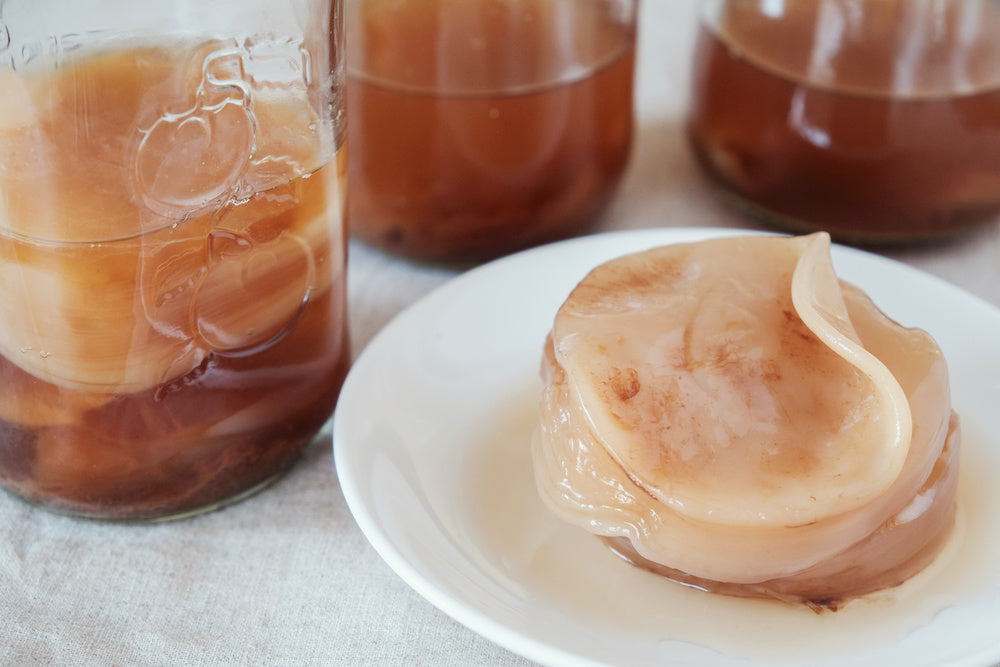
SCOBY stands for "Symbiotic Culture of Bacteria and Yeast". The visible, jelly-like structure consists predominantly of bacterial cellulose, in which microorganisms of the respective kombucha culture are embedded.

The exact bacteria and yeasts present can vary depending on the culture and fermentation conditions.

Can you eat a SCOBY?

A hygienically produced SCOBY can generally be used culinarily. Due to its firm, slightly rubbery consistency, it is, for example, pureed, dried, or processed in small pieces.

However, no general effects on the gut, blood sugar, cholesterol, acid-base balance, or satiety can be derived from consuming a SCOBY.

Therefore, the most important thing is whether you like the taste and consistency.

Zwei Glas Kombucha mit Teepilzen auf Holzkiste

What can you use a SCOBY for?

Excess SCOBYs can be repurposed in various ways:

1. Culinary use

The unique consistency of SCOBY can be tried in sushi variations, smoothies, or other recipes.

2. Try SCOBY jerky

A SCOBY can be marinated and then dried. This changes its consistency, creating an unusual fermented snack.

3. Smoothies and Bowls

Small pieces of SCOBY can be pureed and thus incorporated into smoothies or bowls, for example.

4. For new fermentations

A SCOBY can be used for further kombucha batches along with enough suitable starter liquid.

5. Compost

If you no longer want to use a SCOBY and it contains no unsuitable additives, you can dispose of it with organic waste or compost.

6. DIY and material experiments

Bacterial cellulose is also being researched as a raw material for various material applications. However, this does not mean that a home-grown SCOBY is automatically an equivalent substitute for leather or plastic.

I would not generally recommend SCOBY as pet food. If in doubt, its suitability for a particular animal should be clarified by a veterinarian.

Exciting SCOBY Recipes

Berry SCOBY Smoothie

Ingredients:

  • 30 g SCOBY
  • 60 g frozen strawberries
  • 100 ml rice milk or other milk alternative
  • 100 ml Kombucha Original
  • a little honey or maple syrup 

Preparation:

Blend everything until a smooth consistency is achieved – and your berry SCOBY smoothie is ready!

Apple sauce with SCOBY

Ingredients:

Preparation:

Cut the apples into pieces. Then add them to the kombucha with SCOBY and blend everything until the desired consistency is reached. If desired, cinnamon or a little coconut blossom sugar can also be added. Be sure to store the finished apple sauce in the refrigerator. 

Tip: Wash the apples thoroughly, remove stems and core, then cut into pieces. You can process the peel with it depending on the desired consistency.

SCOBY Energy Balls

These SCOBY Energy Balls combine oats, dried fruit, nut butter, and SCOBY to create a convenient snack for on the go.

Ingredients:

  • 125 g oats
  • 40 g dried cherries, dates, or figs
  • 50 g nut butter
  • 3 spoons of honey
  • vanilla powder, cinnamon, or other spices as desired
  • 30 g SCOBY

Preparation:

Mix all ingredients well and store in the refrigerator for at least 1 hour. Then use a spoon to separate the dough and form small balls. Afterwards, store the finished SCOBY Energy Balls in the refrigerator again.
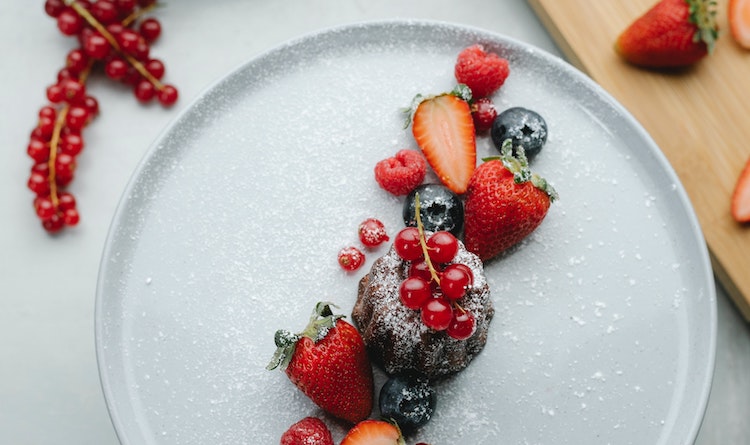
Strawberry SCOBY Sorbet with Rose Petals

Ingredients (makes approx. 750 ml sorbet):

  • 500 g prepared strawberries
  • 100 g honey
  • 150 ml Kombucha Original
  • 2 cl rose essence
  • Juice of 1 lemon
  • 1/2 packet apple pectin
  • 2 handfuls of rose petals

Preparation:

  1. Wash the strawberries and put them in the blender
  2. Then add honey, lemon juice, kombucha, and apple pectin. Puree the ingredients and season the sorbet mixture with lemon and rose essence. The strawberry-kombucha sorbet should now thicken slightly due to the pectin.
  3. Pluck the rose petals and sprinkle them into the sorbet mixture.
  4. The sorbet mixture is now frozen in the ice cream maker, or you can pour the mixture into ice cream molds and let it freeze in the freezer. The soft sorbet also tastes good unfrozen.
Scoby Jerky fertig auf Teller

SCOBY Jerky

Ingredients:

  • 5 to 6 thin kombucha SCOBYs    
  • 1 tablespoon grated ginger
  • 1 tablespoon diced garlic
  • 120 ml soy sauce
  • 7 tbsp honey

Preparation:

  1. Cut the SCOBYs into strips.
  2. Mix the remaining ingredients to form a marinade and soak the SCOBY for 24 hours.
  3. Lay the kombucha SCOBY strips on the rack of your dehydrator.
  4. Dehydrate the strips until most of the moisture has disappeared (approx. 8 hours at 40 °C).
  5. Store your SCOBY jerky at room temperature in an airtight jar and consume within one month.

Notes

The easiest way to get thin SCOBYs for this recipe is to carefully peel off the top layer of the kombucha SCOBY. Alternatively, you can try to separate a thick SCOBY into layers.

If you don't have a dehydrator, you can prepare your SCOBY jerky in the oven. Simply set the oven to the lowest temperature and leave the door ajar with a wooden spoon.

SCOBY Fruit Leather

Tools:

  • Blender
  • Dehydrator
  • Baking paper or dehydrator sheets
  • Offset spatula
  • Pizza cutter or scissors

Ingredients:

  • 500 g SCOBY
  • 125 g fruit puree (strawberry or mixed with raspberry puree)
  • 25 g cup organic sugar

Preparation:

  1. Puree the fruit, add the sugar to the fruit, and set the mixture aside.
  2. Puree the SCOBY at medium speed in the blender.
  3. Add the fruit puree and continue blending until everything is well mixed.
  4. Cut the baking paper to fit the dehydrator tray.
  5. Pour the SCOBY fruit mixture onto the paper on the rack.
  6. Spread the mixture with an offset spatula to all edges (about 1/2 cm thick).
  7. Follow steps 1 to 5 until all trays are filled.
  8. Dehydrate the mixture at 30 °C for 24 to 36 hours or until the mixture is dry and no longer sticky.
  9. Remove the dried mixture from the dehydrator and place it on a cutting board.
  10. With a pizza cutter or scissors, cut 1/2 cm wide strips across the entire dried SCOBY fruit mass.
  11. Leave the dried SCOBY fruit leather on the parchment paper and roll up the SCOBY fruit.
  12. Store in an airtight container.
  13. Remove the SCOBY fruit leather from the paper before eating.

ENJOY!
7 comments

    • Gerda Lübke
    • June 11, 2026 at 2:59 pm

    Ich besitze den kombucha Pilz schon 20 Jahre ,möchte den Pilz der immer weiter wächst,weiter verschenken. Ich grabe den Pilz schon an meinen Hortensien,soviel habe ich mittlerweile,

    • J.N.
    • October 24, 2025 at 2:09 pm

    Ist es Absicht, dass im Erdbeere-Scoby Sorbet mit Rosenblüten kein Scoby als Zutat aufgeführt ist?

    • Olga
    • April 29, 2025 at 11:47 am

    Ich wollte nur mit Euch eine weitere Verwendung von Scoby teilen: ich backe Brot mit meinem Scoby. Ich püriere ihn im Wasser oder auch im fertigen Kombucha, füge dabei etwas Honig/Zucker hinzu, danach stelle ich damit und aus den restlichen Brotzutaten einen Teig her und lasse ihn in den eingefetteten Backformen abgedeckt ca. 2 Tage gehen. Sobald man man die Luftblasen im Teig erkennt, kann man das Brot backen. Es schmeckt sehr gut, wie ein Brot mit Sauerteig, aber es ist etwas weniger sauer. Dadurch verwende ich keine Hefe oder kein Backpulver.

    Bitte meine Email-Adresse nicht veröffentlichen!

    • Lea
    • April 29, 2025 at 11:47 am

    Ich möchte bald mot Kombucha beginnen und den Scoby dann verwerten. Ich frage mich aber, ob der Pilz denn stark nach etwas schmeckt. Ich lese viel von Fischersatz, aber kann mir das nicht vorstellen. Schmeckt er nach Tee? Dann ist er doch weit von Fleisch oder Fisch entfernt, oder? Wie würde man den Geschmack beschrieben? Spannend Spannend. Ich freue mich schon auf’s Testen

    • Marga
    • October 15, 2024 at 10:37 am

    Sollte ich den scoby mixen bevor ich eine Maske herstelle?
    Lieben Dank für deine Antwort.
    Marga

Leave a comment

Please note, comments need to be approved before they are published.

This site is protected by hCaptcha and the hCaptcha Privacy Policy and Terms of Service apply.

Recommended articles for you

More of my articles, from A, like alcohol-free kombucha cocktails, to Z, like lemon-ginger kombucha, can be found on our Kombuchery blog. Let's learn more about kombucha together!

View all

Mate Tee Trinkhalm Mateteegefaess

Mate Kombucha: These Are the Positive Effects of Mate Tea

Our new Kombucha refreshes gently Our new variety Kombucha Mate combines a lightly smoky mate flavor with pleasantly sweet and sour kombucha. This tea from South America has a long tradition and is valued for its beneficial effects on the...

Read moreabout Mate Kombucha: These Are the Positive Effects of Mate Tea

Schwangere Frau im Anschnitt grosser Bauch Wiese Abendsonne

How suitable is kombucha for pregnant women and children? All answers regarding alcohol content!

Who should drink Kombucha? We'll briefly explain how much alcohol is in kombucha and how it's produced. Who should be more careful when consuming the fermented tea drink? Here you'll find all the important information. How is alcohol produced in...

Read moreabout How suitable is kombucha for pregnant women and children? All answers regarding alcohol content!

Warum kann Kombucha Alkohol enthalten? Alle Fragen zum Alkoholgehalt im Überblick

Why can Kombucha contain alcohol? – All your unanswered questions on the topic at a glance!

How is alcohol formed in kombucha? Is there kombucha without alcohol? Can pregnant women drink kombucha? Can I make alcohol-free kombucha? All your questions about kombucha and alcohol answered here!

Read moreabout Why can Kombucha contain alcohol? – All your unanswered questions on the topic at a glance!

10 Fakten zu Kombucha kaufen oder selber brauen Inhaltsstoffe

Fermented Tea Drink – 10 Interesting Kombucha Facts

What else you can learn about Kombucha 1. Kombucha Shelf Life Genuine unpasteurized kombucha has a shelf life of about 3 to 9 months. After bottling, the complete fermentation process does not stop immediately. The tea drink should therefore be...

Read moreabout Fermented Tea Drink – 10 Interesting Kombucha Facts

Wer kann mehr? Der Vergleich: Kombucha, Wasserkefir & funktionale Limonaden

Who can do more? The comparison: kombucha, water kefir & functional lemonades

In recent years, the beverage market has changed significantly. In addition to classic soft drinks, an increasing number of fermented beverages and so-called functional lemonades are available in supermarkets today. Kombucha, water kefir, and modern lemonades with added dietary fibers...

Read moreabout Who can do more? The comparison: kombucha, water kefir & functional lemonades

Kombucha Guide Berlin: Die 10 besten Cafés & Restaurants in 5 Bezirken

Kombucha Guide Berlin: The 10 Best Cafes & Restaurants in 5 Districts

Urban Wellness in Berlin: 5 Neighborhoods Where You'll Find Really Good Kombucha Berlin is one of Europe's most exciting cities when it comes to modern food and drink culture. Kombucha is no longer a niche product here, but part of...

Read moreabout Kombucha Guide Berlin: The 10 Best Cafes & Restaurants in 5 Districts

Kombucha und seine Wirkung: Wissenschaftliche Studien zu Inhaltsstoffen, Fermentation und Gesundheit

Kombucha and Its Effects: Scientific Studies on Ingredients, Fermentation, and Health

Kombucha is one of the most intensively studied fermented beverages in recent years. Modern microbiological, nutritional, and clinical studies show that the beverage has an exceptionally complex biochemical composition. During fermentation, numerous bioactive compounds are formed, including organic acids, polyphenols,...

Read moreabout Kombucha and Its Effects: Scientific Studies on Ingredients, Fermentation, and Health

World Kombucha Day am 21. Februar: Geschichte, Fakten & Tipps zum Feiern

🌍 World Kombucha Day on February 21: History, Facts & Tips for Celebrating

Celebrate the fizzy history of Kombucha Every year on February 21st, kombucha fans worldwide celebrate World Kombucha Day. But why exactly is there such a day? It's simple: it's a tribute to a drink that has delighted, inspired, and refreshed...

Read moreabout 🌍 World Kombucha Day on February 21: History, Facts & Tips for Celebrating

Die besten Nahrungsergänzungsmittel: Gesundheit gezielt unterstützen und Risiken beachten

The Best Supplements: Targeted Health Support and Risk Awareness

Dietary Supplements: When Dietary Supplements Can Be Beneficial In today's stressful world, many people don't always manage to eat an optimally healthy diet every day. Shift work, long days in the office, little time for fresh cooking, or simply a...

Read moreabout The Best Supplements: Targeted Health Support and Risk Awareness

Nouvelle formule avec de la vitamine C issue de l'acérola : *La vitamine C contribue au fonctionnement normal du système immunitaire, à un métabolisme énergétique normal et à la protection des cellules contre le stress oxydatif.
  • La vitamine C contribue au fonctionnement normal du système immunitaire.
  • La vitamine C contribue à des fonctions psychologiques normales.
  • La vitamine C contribue à un métabolisme énergétique normal.
  • La vitamine C contribue à réduire la fatigue.
  • La vitamine C contribue au fonctionnement normal du système nerveux.
  • La vitamine C contribue à protéger les cellules contre le stress oxydatif.
  • La vitamine C contribue à la régénération de la forme réduite de la vitamine E.
  • La vitamine C contribue à la formation normale de collagène pour assurer la fonction normale de la peau.
  • La vitamine C contribue à la formation normale de collagène pour assurer la fonction normale des vaisseaux sanguins.
  • La vitamine C contribue à la formation normale de collagène pour assurer la fonction normale des os, des cartilages, des dents et des gencives.
  • La vitamine C augmente l'absorption du fer.