



Qu'est-ce qu'un SCOBY ?
Vous vous êtes certainement déjà demandé ce que signifiait le mot SCOBY ou d'où il venait. SCOBY est l'abréviation anglaise de SYMBIOTIC CULTURE OF BACTERIA AND YEASTS. En d'autres termes, il s'agit d'une symbiose de bactéries et de levures.
Au fil des siècles, en plus du mot SCOBY, la désignation "champignon de thé Kombucha" s'est établie dans la société. Il ne s'agit pourtant pas d'un véritable champignon.
De quoi est composé un Scoby et comment est-il structuré ?
Le Scoby n'est en fait pas un véritable champignon de thé. C'est plutôt une matrice de cellulose colonisée par des bactéries et des levures, et donc ni un champignon classique ni un lichen. Cette substance est à son tour maintenue par la cellulose. Les levures et les bactéries vivent pour ainsi dire en communauté et se favorisent mutuellement. Les levures produisent par exemple de l'alcool, dont les bactéries se nourrissent à leur tour, produisant ensuite de l'alcool et de l'oxygène, de précieux acides organiques.
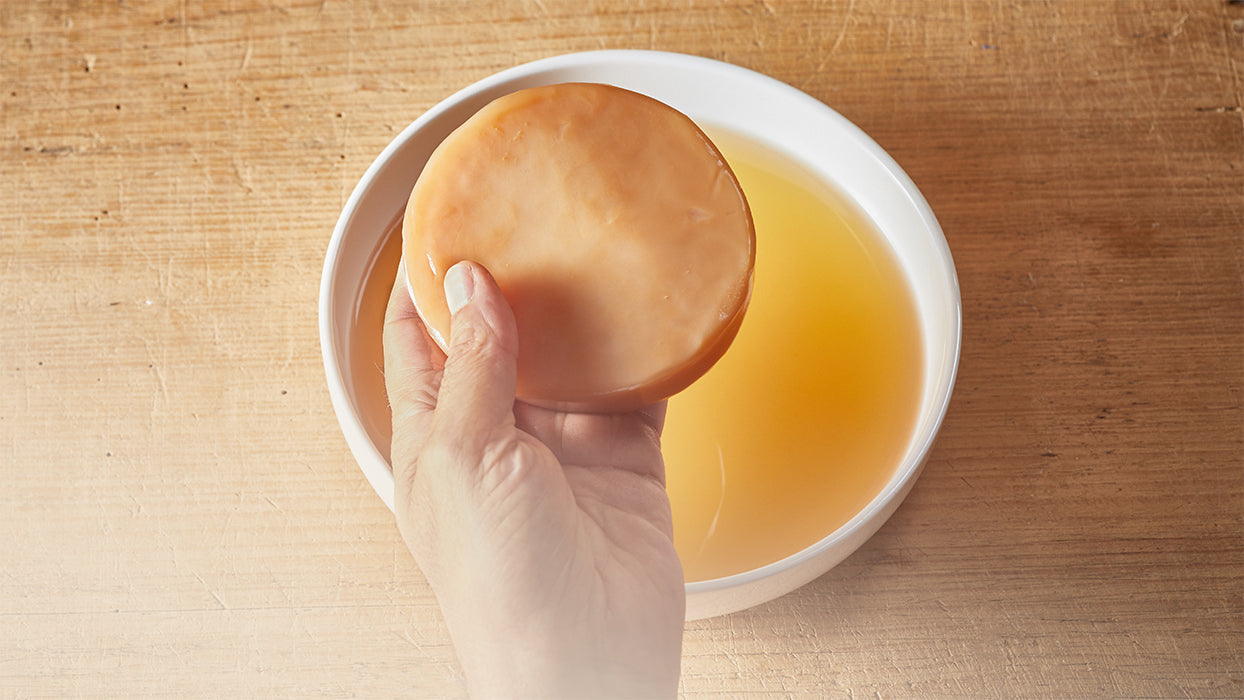
Même si les Scobys présentent de nombreuses variations visuelles, il est généralement rond comme une crêpe et sa consistance est un peu gélatineuse. Sa surface peut être lisse, mais aussi très irrégulière. Pendant le processus de fermentation, des trous ou de petites bosses peuvent également apparaître dans le Scoby – c'est tout à fait normal ! Selon la proportion de liquide, le champignon de thé Kombucha est plus ou moins translucide dans sa composition.

Comment fonctionne un Scoby ?
Le champignon de thé Kombucha se répand d'abord en surface sur la solution nutritive. Il cherche d'abord à capter le plus d'oxygène possible. Cela épaissit la culture de champignon de thé sous-jacente ou un nouveau Scoby se forme. Le Scoby forme toujours de nouvelles couches rapprochées et devient ainsi de plus en plus épais. Dans certains cas, le Scoby coule au fond du récipient de fermentation. Un nouveau champignon de thé se forme alors à la surface et le Scoby au fond du récipient arrête sa croissance.
Nous vous expliquons comment faire pousser votre propre Scoby avec un peu de patience, les bons ingrédients et un équipement très simple !
Il vous faut :
- 1 grand récipient en verre à large ouverture – bien rincé sans liquide vaisselle ! (le vinaigre est un nettoyant pratique)
- Thé – par exemple du thé vert, du thé noir (sans arômes/additifs artificiels)
- Sucre de canne brut biologique
- Eau – si possible filtrée
- Kombucha non pasteurisé (par exemple Kombucha Original)
- 1 linge propre et perméable à l'air
- Environnement pour le Scoby : 1 pièce avec une température entre 20 et 30 degrés
Et c'est parti :
- Faire bouillir le thé avec le sucre de canne pendant 8 à 10 minutes (8g de thé par litre / 60g de sucre de canne bio par litre)
- Verser le mélange thé-sucre dans le récipient en verre et laisser refroidir, de préférence toute la nuit. Important : couvrir le verre avec le linge propre perméable à l'air et le fixer avec un élastique ou un ruban !
- Le sucre doit être complètement dissous
- Il est maintenant temps d'ajouter le Kombucha non pasteurisé, dans un rapport de 1 pour 10
- Fixer ensuite à nouveau le linge sur le récipient et placer le verre dans un endroit sûr

Selon les conditions, la formation du champignon Kombucha peut prendre de 7 à 21 jours. Au début, de petites bulles de mousse semblent se former à la surface du liquide. Celles-ci deviendront de plus en plus denses avec le temps jusqu'à ce que le Scoby devienne lentement reconnaissable.








Partager:
2 commentaires
Hallo Miri,
die Flüssigkeit kannst du für ein SCOBY-Hotel oder als Ansatzflüssigkeit für neuen Kombucha verwenden. Beim neu ansetzten, sollten 100-150ml pro Liter immer Ansatzflüssigkeit (sehr saurer und starker Kombucha) sein. Liebe Grüße!
Hallöchen,
so jetzt habe ich meinen eigenen Scoby 🥳 und einen fertigen Kombucha? Oder ist die Flüssigkeit vom „Scobyzüchten“ nicht zu gebrauchen und ich muss einen neuen Kombucha ansetzen?
Kann ich auch in dieser Flüssigkeit meinen Scoby aufbewahren, wie in einem Scobyhotel?
Danke euch 🫶🏼